
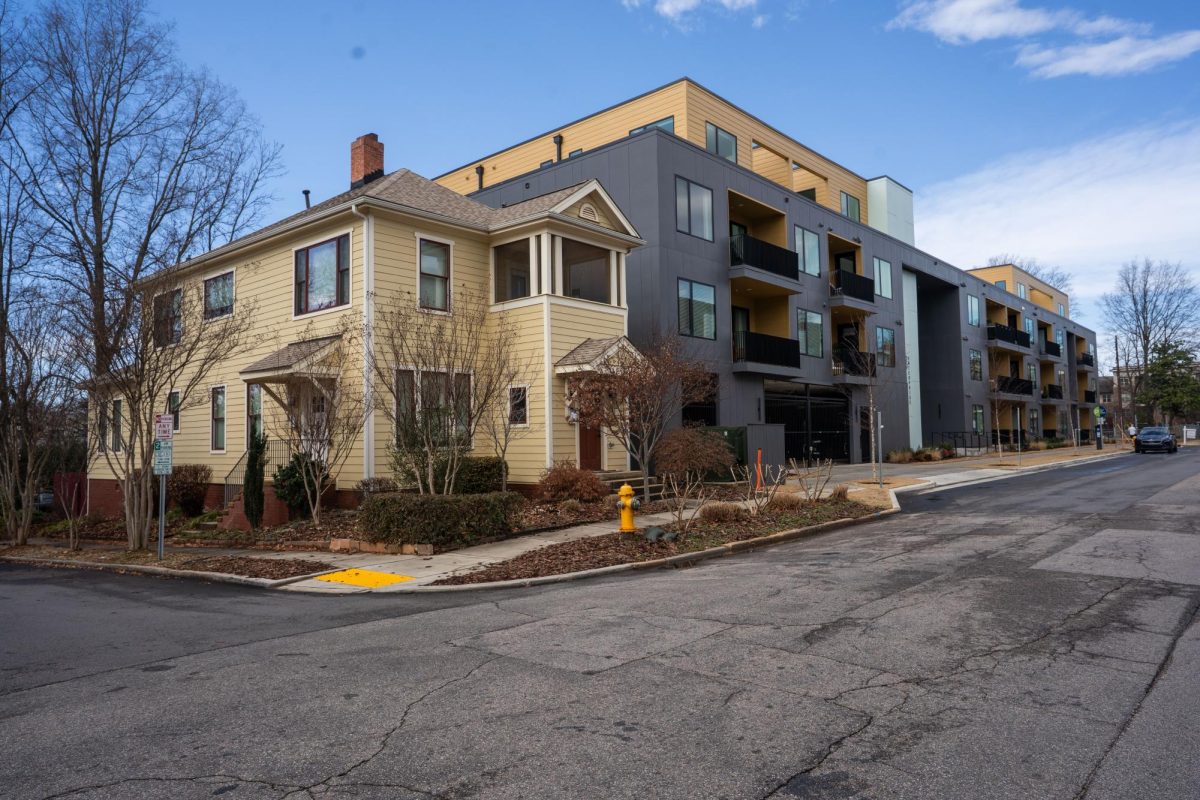
As development continues in Raleigh and around NC State, concerns around gentrification displacing low-income, disadvantaged communities and residents of color have surfaced.
While average housing prices around Hillsborough Street have fallen from a 2022 high of $517,649, they still remain above the five-year low of $415,645, currently sitting at $464,643.
Jonathan Lambert-Melton, at-large city council member for the city of Raleigh, stated that a lot of gentrification pressure stems from the lack of housing availability.
“If we don’t have enough homes for people, then folks will go into areas that are typically more affordable, maybe less-served,” Lambert-Melton said. “All of that pressure on vulnerable communities is occurring because we don’t have enough homes, and it’s just funneling this pressure into areas where land is cheaper, where the homes are more affordable. And that’s what’s causing the gentrification and displacement.”
Jeff Murison, President and CEO of the Hillsborough Street Community Service Corporation (commonly seen on Hillsborough Street stylized as “Live it Up! Hillsborough Street”), agreed that increasing the overall supply of housing, particularly on Hillsborough Street, is an important element of ensuring affordability in the housing supply.
“There are times when there’s properties and buildings that have seen better days, and when they get replaced and new buildings are built that can house a lot more residents, that helps solve the housing availability challenges that Raleigh and many cities are facing,” Murison said.
Repurposing certain historic buildings, such as converting the former Umami Asian Bistro into a Raising Cane’s, while preserving others, is important to the character of the street, he added.
Allowing more types of housing in more parts of the city and Wake County through zoning changes could help spread out development and reduce gentrification and displacement, Lambert-Melton said. He also said opening up other, wealthier parts of the city to further development has also helped to reduce gentrification.
“The work we’re doing in Raleigh to open up other parts of the city, quite frankly, areas that are typically wealthier and white, to different types of housing, is helping absorb some of that demand,” Lambert-Melton said.
Lambert-Melton pointed to the example of a recent townhome development in a wealthy community, stating that increasing the supply of housing in a wealthier community reduces displacement pressure on lower-income and disadvantaged communities.
Oftentimes, new developments and zoning changes are accompanied by affordability requirements, such as in the new Transit Overlay District, allowing further development around GoRaleigh’s upcoming bus rapid transit routes, including one on Western Boulevard. Height is capped at four stories, unless a developer agrees to keep 20% of additional units affordable at 60% of the area median income for 30 years.
“The idea is to change land use along these transit routes to absorb the demand, so it’s not spilling out and displacing and gentrifying neighborhoods around, provide the retail so folks who have lived there a long time can take advantage of both the transit and new retail amenities,” Lambert-Melton said.
To avoid displacement and gentrification, Lambert-Melton added that relocation assistance is often required in projects that would replace already existing naturally affordable housing. Factoring in community input to the process is also important to Lambert-Melton.
A combination of subsidy and zoning changes is necessary to ensure housing remains affordable and communities are not displaced or broken up by gentrification. Lambert-Melton pointed to the Raleigh Area Land Trust, an area nonprofit working to preserve affordable housing that the city recently partnered with for a small affordable housing development.
“The folks who move in there own the structure, but not the land, so that helps with their property taxes and the cost of their home, and then when they sell it, it will remain affordable as well.”
Lambert-Melton encouraged further zoning changes to increase housing supply, such as allowing single-room occupancy buildings — operating similar to a college dorm with bedrooms available to rent — and single-stair buildings, allowing buildings to be constructed with only one stairwell, as is often seen in cities such as New York.
There are various other tools the city is using to reduce displacement, Lambert-Melton said. The city has funded eviction assistance programs through Campbell Law School. The city also provides funds for owner-occupied rehabilitation assistance, helping residents stay in their homes by assisting with major repairs and expenses.
The city does not have as many tools at its disposal as other places due to limitations placed on it by state law, Lambert-Melton added.
Hillsborough Street maintains a range of options with different price points, helping to enable affordability, Murison said.
“There’s a range of options for places to live on our street, both traditional market-rate residential and purpose-built student housing. Those are two slightly different markets with different price points, but within both, there’s a range of options,” Murison said. “There can always be, and needs to be more of a range to make sure that as many people have the opportunity to live, work and play here as possible.”
Murison added that the increased foot traffic Hillsborough Street has seen is critical to ensuring long-term tenants and businesses can stay in the area.
“One of the best ways to keep our traditional merchants, that have been here for a long time, open and successful is to have a steady stream of customers, so we do a lot to keep the corridor clean, safe and welcoming,” Murison said. “Repeat customers help keep all of our merchants open, but especially the ones that have been here a long time.”
Looking to the future, Lambert-Melton said reducing homelessness and keeping communities together are critical metrics for success in reducing gentrification.
“No one living on the street or in a place that’s not habitable for human life. Zero unhoused community members would be a win for me,” Lambert-Melton said. “Maintaining socioeconomic and racially diverse communities would be a win, making sure that folks who are longtime residents can take advantage of new amenities that are being built in their communities, rather than being displaced by the increase in interest drawn by the new amenity.”